PT-141 clinical outcomes
Reducing distress about low desire is a meaningful treatment question. Nausea and blood-pressure effects make the answer less comfortable.
RECONNECT outcomes
PT-141 is the research designation for bremelanotide, a synthetic cyclic peptide acting on central melanocortin receptors involved in sexual motivation. Its clinical story concerns a particular form of distressing low sexual desire.
The two randomized Phase 3 trials enrolled premenopausal women with hypoactive sexual desire disorder. Compared with placebo, bremelanotide improved average desire and reduced associated distress. The approved indication concerns acquired, generalized low desire: a loss from an earlier level that occurs across partners or situations.
I appreciate that distress received its own measurement. Desire varies, and an argument for treatment has to take the woman's experience seriously. Group averages leave room for very different personal judgements about the value of the change.
Extension tolerability
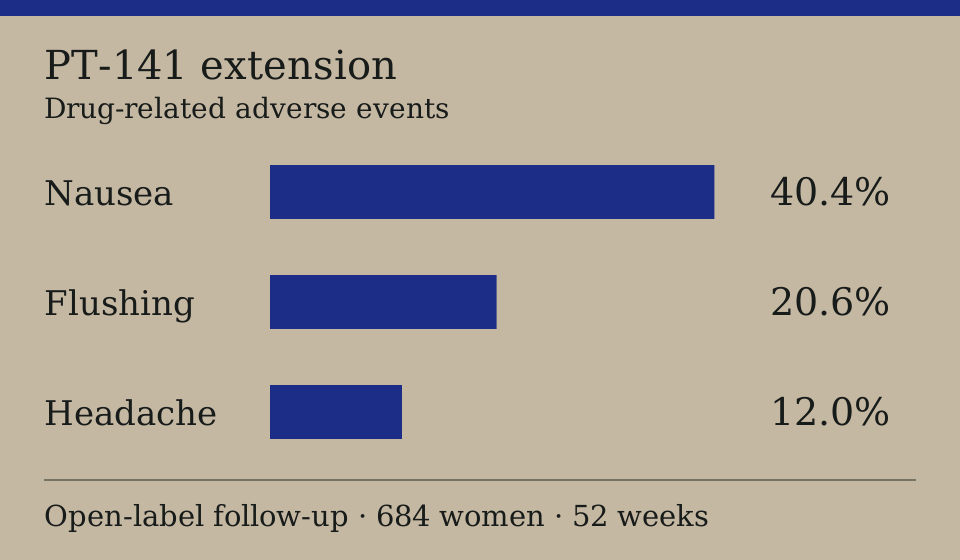
In the 52-week open-label extension, which enrolled 684 women, improvements in desire were sustained and no new safety signals emerged. The most common drug-related treatment-emergent adverse events were nausea at 40.4%, flushing at 20.6% and headache at 12.0%. Everyone knew which treatment they were receiving in this extension.
I take nausea seriously as a competing outcome here. A treatment aimed at desire and distress can become burdensome through the way it makes someone feel. The figures below describe reported adverse events in this extension; they give no prediction for an individual woman and no comparison with a concurrent placebo group.
Brain processing and sexual reward
A placebo-controlled crossover brain-scan study in women with low desire found increased reported desire and altered processing of sexual images. The scans help investigate a central mechanism, while the women's reports provide the evidence about how desire felt.
A later experiment in female Syrian hamsters asked about sexual reward through conditioned place preference: whether the animal favoured a place associated with previous sexual activity. Bremelanotide did not enhance that preference. It also did not increase melanocortin-receptor messenger RNA in the examined reward system.
The negative hamster result sharpens the distinction between wanting and reward. It does not overturn the women's desire trials. The experiments measured different aspects of sexual behaviour, in different species, and a sweeping claim about enhanced pleasure would blur them.
Bremelanotide prescribing information
The US prescribing information limits the approval to acquired, generalized hypoactive sexual desire disorder in premenopausal women. It excludes men, postmenopausal women and general sexual-performance enhancement. Research material called PT-141 sits outside the approval of the prescription medicine.
Bremelanotide can temporarily raise blood pressure and slightly lower heart rate. Known cardiovascular disease and uncontrolled hypertension are contraindications. Repeated use can also produce dark patches of skin or mucous membranes. Those are concrete restrictions around an otherwise appealing treatment aim.
The cardiovascular question here is quite different from semaglutide's cardiovascular outcome trials. A shared peptide category supplies no shared safety profile.

Community experiences
Reports outside the trials describe stronger desire, greater sensitivity or easier orgasm, alongside nausea, flushing, headache, local irritation and sometimes no benefit. Men also report sexual effects outside the approved population. These are anecdotal accounts, not clinical evidence, and they cannot establish how often an effect occurs or whether the substance caused it.
I object to extending the desire result beyond the women in the trials. The controlled studies concern distressing low desire in a defined group of women. The cost in adverse effects has to be considered within that treatment question, with no assumption that the same balance applies elsewhere.